Our recommendation
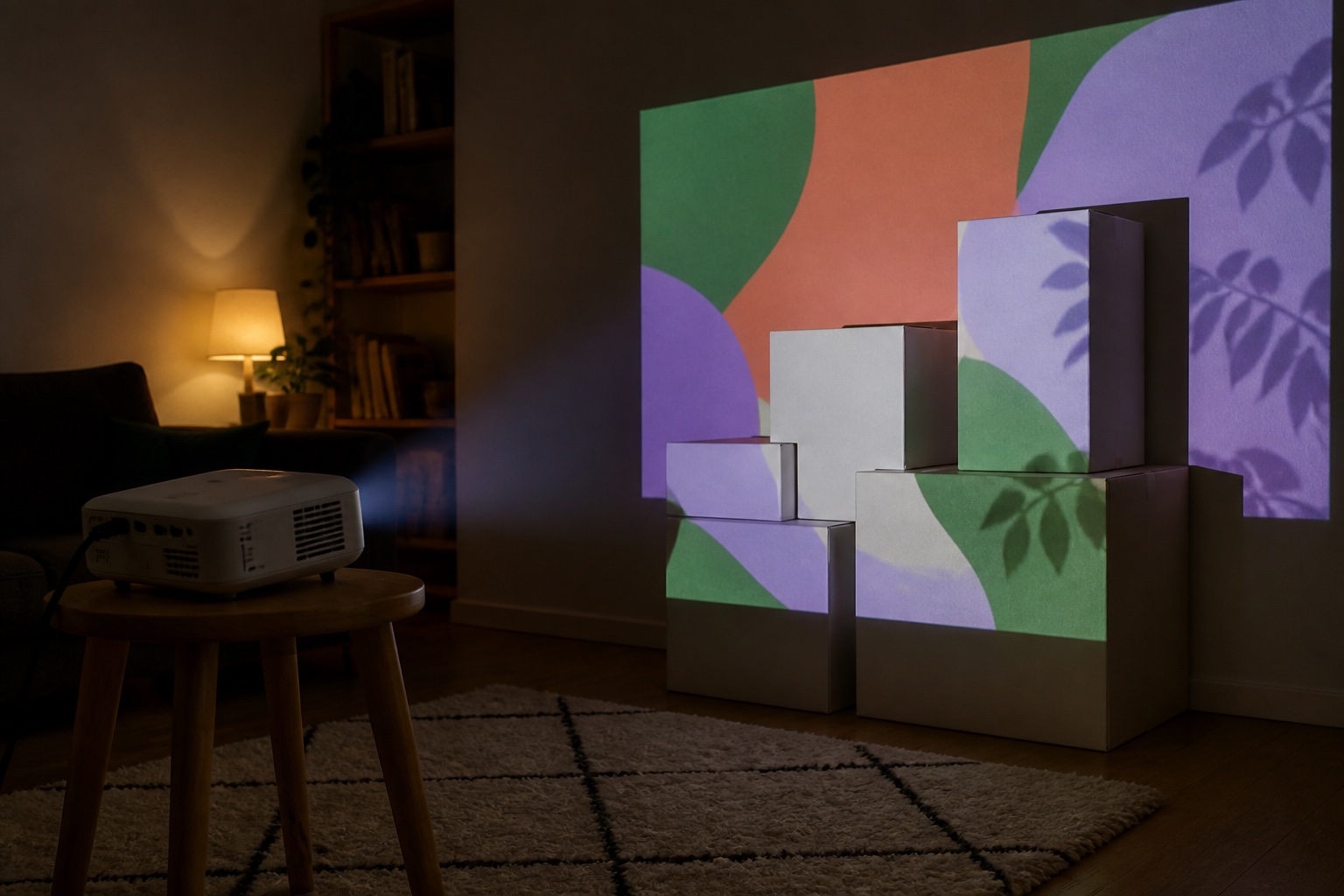
After dark, indoor objects, props and a rear-projected window work from about 300 ANSI lumens, or 1,000+ if a bright street or dusk light competes. A wall in a dim room needs about 500–1,000, and a room with the lights on 2,000 or more. Outdoors, a garage door or single wall starts around 3,000, and a full house front needs 4,000–5,000 or more. Treat these as starting points, not guarantees.
Useful starting ranges
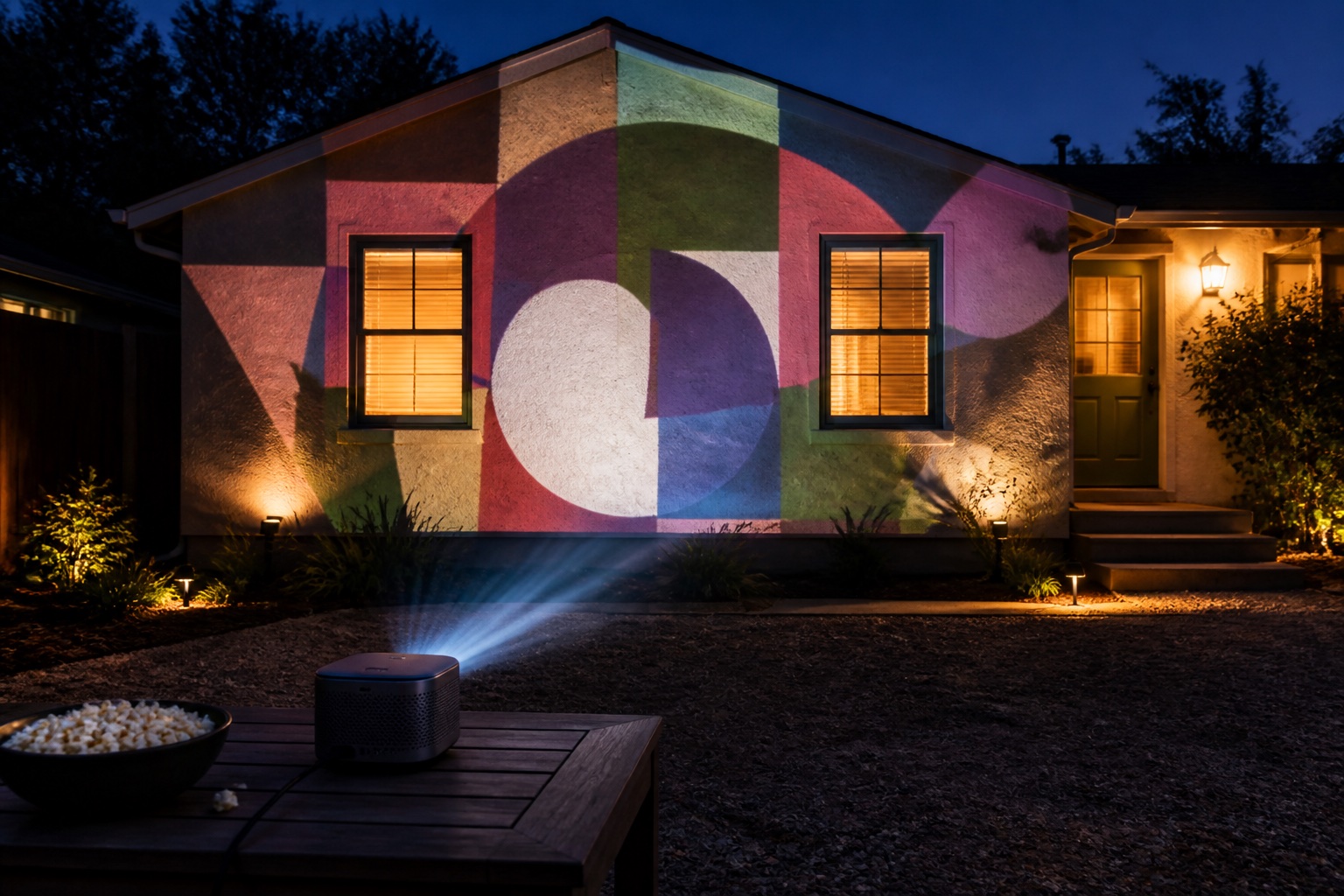
A compact 300-lumen projector such as the Nebula Capsule 3 Laser makes saturated color on props, a few boxes or a rear-projected window in a dark room. At six or eight feet wide on a wall, that same output looks much weaker, so a dim-room wall wants 500–1,000 and a room with the lights on 2,000 or more. Outdoors, a garage door after full darkness starts around 3,000, and a full house front 4,000–5,000 or more. None of these is a daylight solution.
Professional facade work may use projectors rated at 10,000, 20,000, or many more lumens, sometimes in stacks. That does not mean every residential holiday display needs professional equipment. Surface width, color, viewing distance, and nearby lighting determine the result.
- Indoor objects, props and window rear-projection after dark: about 300 ANSI lumens and up (1,000+ with a bright street or at dusk)
- A wall in a dim room: about 500–1,000
- A room with the lights on: 2,000 or more
- Outdoor garage door or wall: about 3,000 or more
- Full house front: 4,000–5,000 or more
Why image size changes everything
Brightness is spread across area. If you double both width and height, the image covers four times the area, so each square foot receives roughly one quarter of the light before other losses. This is why reducing the mapped canvas can improve color more dramatically than buying a projector with a modest lumen increase.
Map only the architectural section that matters. Black out unused pixels in software and avoid wasting image area beyond the surface. Optical zoom and correct throw placement help use the projector's panel efficiently.
ANSI, ISO, LED, and light-source lumens
ANSI and ISO labels refer to defined measurement approaches. They are not perfectly interchangeable in every listing, but both are more useful than a huge number with no standard attached. LED lumens and light-source lumens may describe perceived or source output rather than measured projected white light.
Do not convert a five-digit marketplace claim to ANSI lumens using a universal formula. If the manufacturer will not state the test standard, compare independent measurements or choose a model with documented output.
Ambient light and black level
A projector adds light; it does not remove it. Wherever the content is black, the audience sees the underlying surface and ambient illumination. Streetlights, porch fixtures, windows, and event lighting lift the apparent black level and reduce contrast across the whole illusion.
Turn off nearby lights, choose a darker viewing window, aim away from direct sources, and use pale matte surfaces. A brighter projector helps highlights, but controlling ambient light often produces the larger improvement.
Surface color and material
White and light neutral matte surfaces reflect light efficiently. Dark brick absorbs more. Glossy paint can create hot spots, glass can transmit or reflect unpredictably, and foliage breaks an image into moving fragments. Test with the actual material.
If the surface is colored, build content that uses that color rather than trying to erase it. Bright saturated accents and high-contrast line work survive better than low-contrast cinema footage on an imperfect facade.
How to run a brightness test
Borrow, rent, or use the projector you already own. Place it at the real distance, wait for the real darkness level, and project a test containing white, primary colors, mid-gray, black, fine lines, and a short piece of intended content. Photographing the result is useful, but judge it with your eyes because phone exposure can exaggerate brightness.
Reduce the width until the result looks solid, then record the usable size. This reveals more than a generic calculator because it includes the surface, local lighting, and projector mode.
Frequently asked questions
Are 1,000 lumens enough for projection mapping?
Yes for props, boxes, windows and a wall in a dim room, and for small after-dark outdoor effects. It is not enough for a garage door (about 3,000 or more) or a full house front (4,000–5,000 or more).
How many lumens do I need for a garage door?
About 3,000 documented ANSI or ISO lumens after full darkness is a useful starting point for a garage door or single outside wall. Width, door color, nearby lights, and throw losses can raise that; a full house front needs 4,000–5,000 or more.
How many lumens do I need for a window projection?
Rear-projecting onto a window film or sheet from inside a dark room works from about 300 ANSI lumens. Allow 1,000 or more if a bright street or dusk light shines on the window from outside.
Can projection mapping work in daylight?
Ordinary consumer projection mapping is generally ineffective in daylight. Daylight produces an extremely high ambient-light level that overwhelms projected contrast.
Are advertised LED lumens the same as ANSI lumens?
No. Different labels and undocumented marketplace claims should not be treated as equivalent. Look for a stated ANSI or ISO measurement standard.
Prices, availability, and specifications can change by market and date. Confirm current manufacturer documentation and the retailer listing before purchasing.