Our recommendation
Indoors, start with the Anker Nebula Capsule 3 Laser: the projector we use in our own videos, small enough to sit on a tripod beside props, boxes or a window, with a battery and Google TV built in. Outdoors, for a garage door or the front of a house, choose the XGIMI Horizon 20 Pro, which is bright enough to hold color on a large surface after dark. Whichever you pick, put it on a stable tripod or stand.
Quick comparison
| Projector | Best for | Brightness (lumens) | Rating standard | Resolution | Throw ratio | Where to buy |
|---|---|---|---|---|---|---|
| Anker Nebula Capsule 3 Laser | Best indoors (our first pick) | 300 | ANSI | 1920×1080 | 1.2:1 | View on Amazon ↗ |
| XGIMI Horizon 20 Pro | Best outdoors and for house fronts | 4,100 | ISO | 3840×2160 (pixel-shift) | 1.2–1.5:1 | View on Amazon ↗ |
| BenQ TH575 | Bright garage door on a budget | 3,800 | ANSI | 1920×1080 | 1.49–1.64:1 | View on Amazon ↗ |
| Optoma GT2000HDR | Short-throw layouts | 3,500 | Not stated | 1920×1080 | 0.496:1 | View on Amazon ↗ |
| Nebula Mars 3 | Brighter battery-powered setups | 1,000 | ANSI | 1920×1080 | 1.2:1 | View on Amazon ↗ |
| Epson EpiqVision Flex CO-FH02 | Rooms where some lights stay on | 3,000 | ISO | 1920×1080 | 1.19:1 | View on Amazon ↗ |
| ViewSonic PX701-4K | Detailed artwork indoors | 3,200 | ANSI | 3840×2160 (pixel-shift) | 1.5–1.65:1 | View on Amazon ↗ |
Anker Nebula Capsule 3 Laser
Used hands-on by the Lazy Lighting team
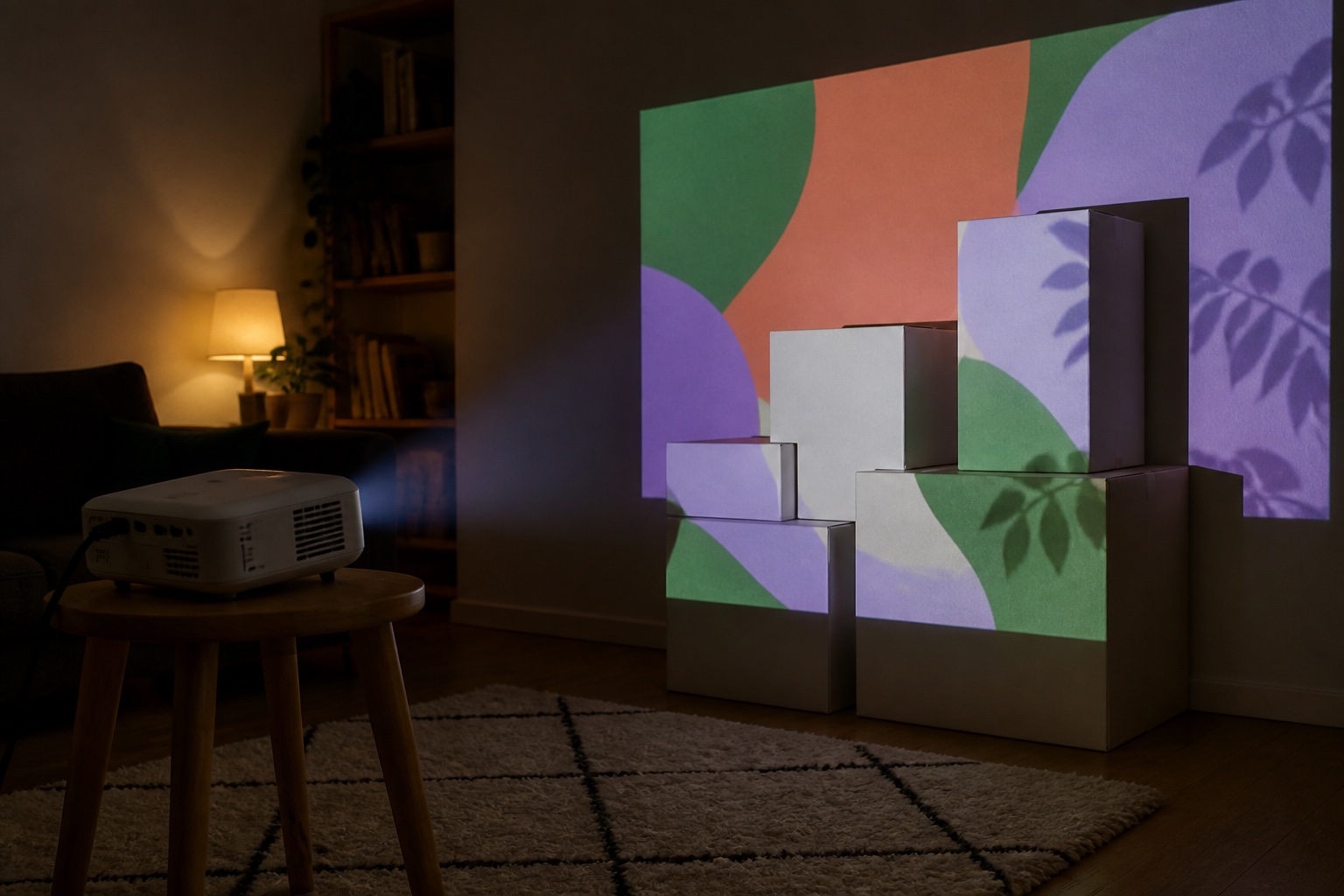
Best indoors (our first pick). The projector we use in our own videos. It is small, battery powered (about 2.5 hours), has Google TV built in and a standard tripod thread, so it is easy to aim at props, boxes or a window after dark.
Check price & availability (paid link) ↗XGIMI Horizon 20 Pro
Specs-based pick
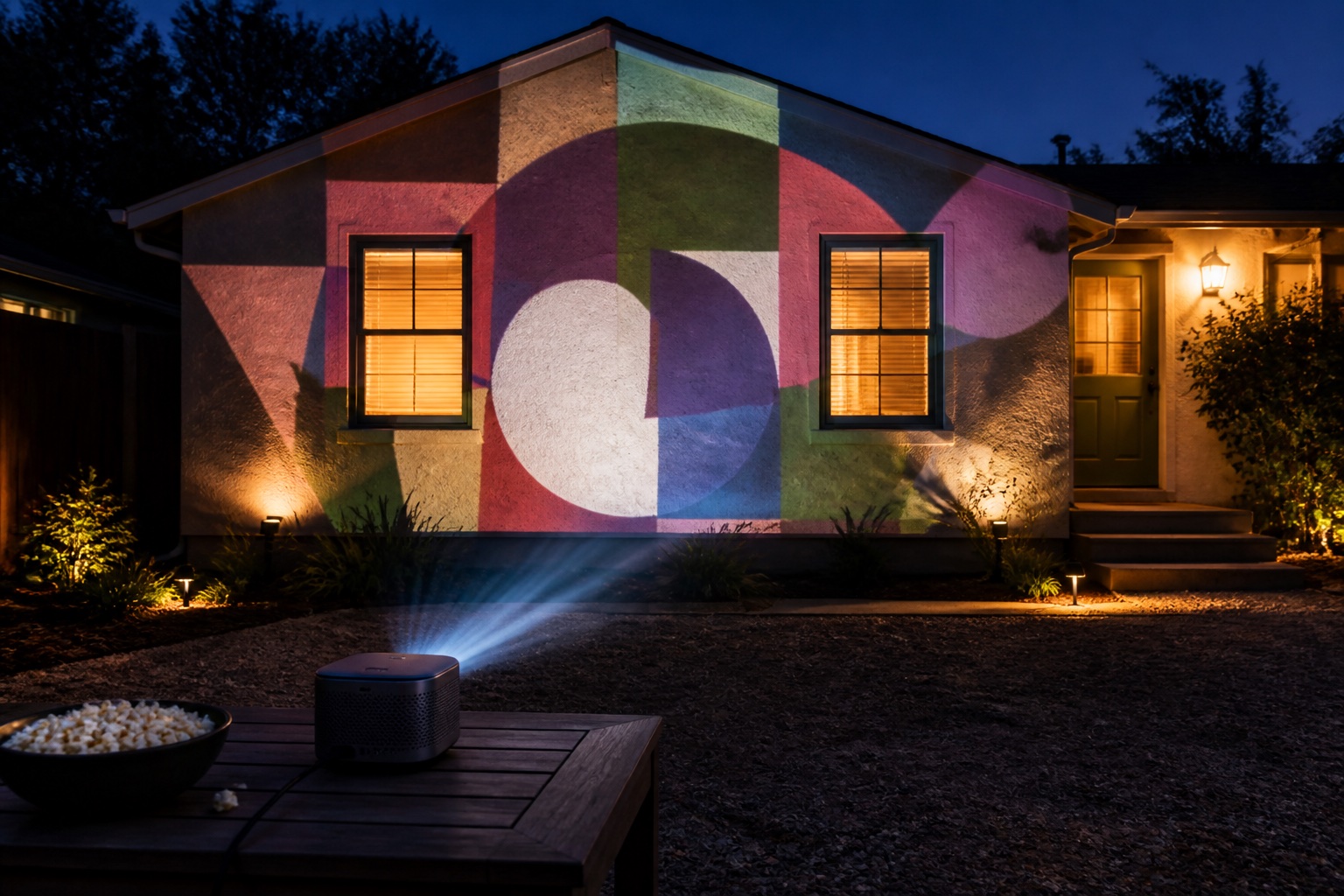
Best outdoors and for house fronts. Triple-laser output, optical zoom and lens shift make it the easiest way to fill a garage door or the front of a house after dark. Google TV is built in; it needs mains power.
Check price & availability (paid link) ↗BenQ TH575
Specs-based pick
Bright garage door on a budget. A lower-cost, brightness-first option for a garage door when you can run mains power and do not need portability.
Check price & availability (paid link) ↗Optoma GT2000HDR
Specs-based pick
Short-throw layouts. A short throw fills a wide surface from close range, which reduces shadows from people walking past.
Check price & availability (paid link) ↗Nebula Mars 3
Specs-based pick
Brighter battery-powered setups. More output than the Capsule for a wall in a dim room or a short evening setup, with a battery and handle.
Check price & availability (paid link) ↗Epson EpiqVision Flex CO-FH02
Specs-based pick
Rooms where some lights stay on. Ample rated brightness for indoor walls when you cannot make the room fully dark.
Check price & availability (paid link) ↗ViewSonic PX701-4K
Specs-based pick
Detailed artwork indoors. Finer on-screen detail for intricate artwork when the source and surface justify it; it needs more distance than the Capsule.
Check price & availability (paid link) ↗How we chose: the Anker Nebula Capsule 3 Laser is the projector the Lazy Lighting team uses hands-on, including in our own videos. The other picks are based on manufacturer specifications; we have not tested them ourselves. Check current specifications and availability before buying. As an Amazon Associate we earn from qualifying purchases.
What else you need
- Tripod: K&F Concept 64" tripod. Fits the standard tripod thread on compact projectors like the Capsule 3 Laser and lifts the lens above props, sills and railings. Check price & availability (paid link) ↗
- Phone or tablet adapter: USB-C to HDMI hub. Connects a USB-C phone, tablet or laptop to the projector's HDMI input, with power pass-through for longer sessions. Check price & availability (paid link) ↗
How we would choose
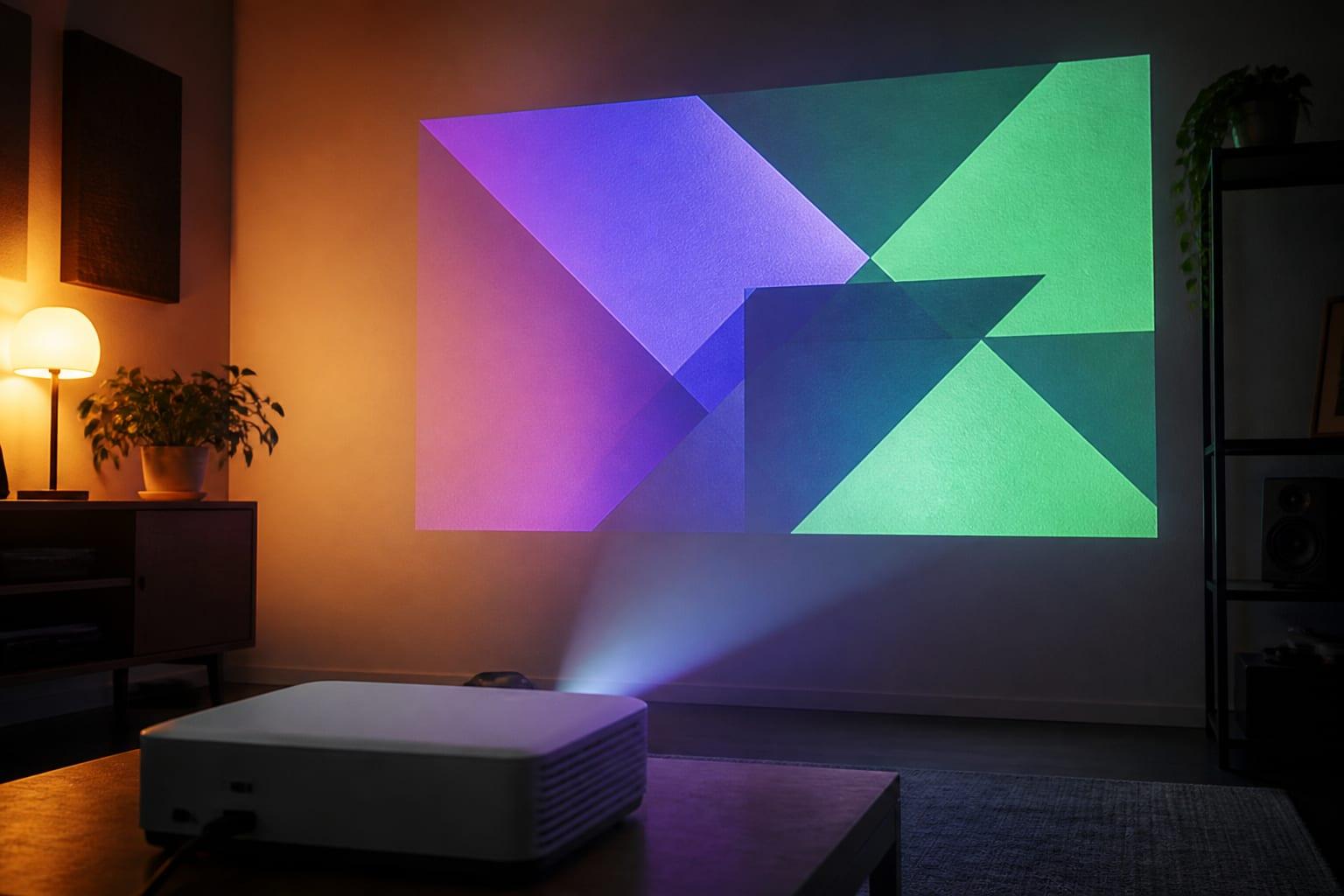
The best projector is the one that fills your intended surface from the position you can actually use. Start with what you are mapping and where, then check surface width, available distance and how dark the space will be.
- Indoor props, boxes and windows: a compact projector like the Capsule 3 Laser on a tripod, in a dark room.
- Garage doors and house fronts: a bright mains-powered projector like the Horizon 20 Pro, after dark.
- Rooms where lights stay on: more output, such as the Epson CO-FH02, or a smaller image.
A warning about brightness
Low-cost marketplace projectors frequently advertise numbers that cannot be compared with standardized ANSI or ISO measurements. Treat an unexplained five-digit lumen claim as marketing, not as a usable comparison. Our lumens guide sets out how much light each kind of project needs.
What we would buy first
A beginner should usually avoid paying for 4K before confirming throw distance and brightness. A well-placed 1080p projector in a dark environment can produce a more convincing mapped result than a poorly placed 4K model.
How throw distance changes the ranking
A projector can be the best value on paper and still be unusable in your room. Multiply the desired image width by the manufacturer’s throw ratio to estimate lens distance, then add space for the chassis, cables, and ventilation. Our throw distance guide has worked examples and a chart for common surfaces.
Short throw is valuable when viewers would otherwise cross the beam, but it makes small placement and focus errors more obvious. Ultra-short throw is easiest on a flat plane and can create severe shadows on deep objects.
Resolution, contrast, and the surface
Real 1080p is enough for most home mapping. Many consumer “4K” projectors, including the Horizon 20 Pro and PX701-4K, put 3840×2160 on screen by pixel-shifting a lower-resolution chip; that looks sharper than 1080p but is not native 4K. Pixel count cannot rescue an image washed out by ambient light.
Pale matte surfaces return more useful light than dark brick, glass, or glossy paint. Build bold edges and high-contrast motion for textured architecture instead of expecting cinema-screen black levels.
Portable versus installed
Battery models are easy to place for a window, tabletop object, or temporary yard effect, and a tripod makes them easier still. Their lower output means the image must usually stay smaller and the environment darker. A mains-powered model is the better garage-door purchase.
Whichever format you choose, disable automatic screen fit after alignment, secure the support, and record the final position. Repeatable geometry is a mapping feature even though it never appears in a projector headline.
How we chose these picks
The Nebula Capsule 3 Laser is the projector the Lazy Lighting team uses for its own videos, so that recommendation comes from hands-on use. The other six are specifications-based picks: we compared manufacturer data, throw ratio, connections and use cases, but we have not tested them ourselves. Each pick is labeled accordingly.
Before purchase, follow the linked manufacturer page, verify the regional model, and use its throw calculator. Prices and firmware change faster than the underlying advice about darkness, coverage, and safe placement.
Frequently asked questions
What is the best projector for projection mapping?
Indoors, the Anker Nebula Capsule 3 Laser, which we use in our own videos: it is compact, battery powered and easy to put on a tripod beside props or a window. Outdoors, for a garage door or house front, the XGIMI Horizon 20 Pro. The BenQ TH575 is the lower-cost bright option, and the Optoma GT2000HDR is the short-throw pick.
How many lumens are needed for projection mapping?
After dark, indoor props and a rear-projected window work from about 300 ANSI lumens, a wall in a dim room needs about 500–1,000, a room with the lights on 2,000 or more, a garage door about 3,000 or more, and a full house front 4,000–5,000 or more.
Do I need a 4K projector for projection mapping?
No. 1080p is sufficient for most consumer maps. Prioritize throw distance, real brightness, and stable alignment before 4K.
Prices, availability, and specifications can change by market and date. Confirm current manufacturer documentation and the retailer listing before purchasing.