
Our recommendation
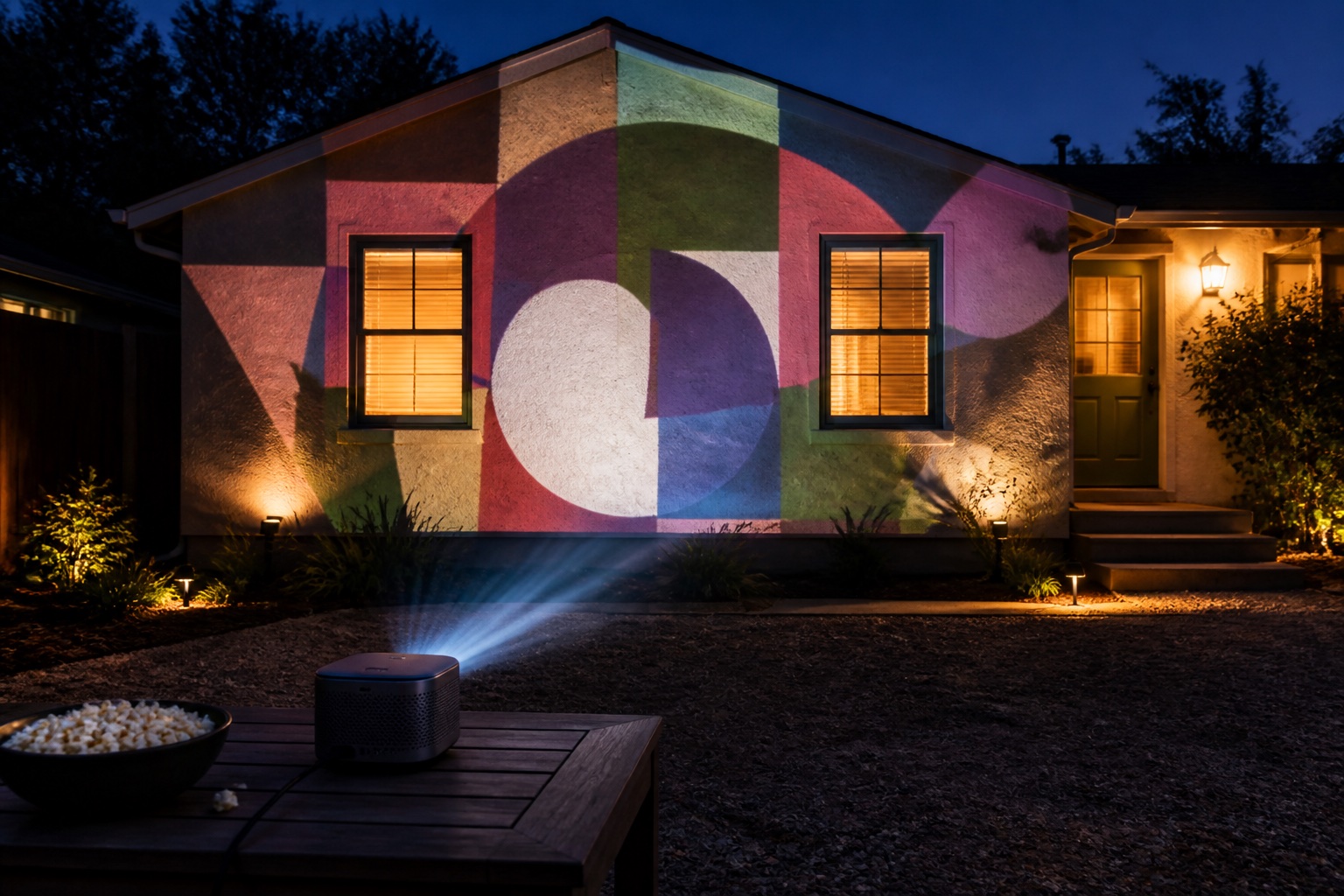
If you want moving color and shapes washing over the front of the house all season with no fuss, a pattern-style Halloween light projector is fine: it is cheap, it plugs in, and many are sold as weather-resistant. If you want a ghost in a particular window, a face on the garage door, singing pumpkins, or anything fitted to the shape of your house, you need a real video projector. For windows and props, the Nebula Capsule 3 Laser; for garage doors and house fronts, the XGIMI Horizon 20 Pro. A “hologram projector” is a screen-and-content trick that any video projector can do.
Quick comparison
| Projector | Best for | Brightness (lumens) | Rating standard | Resolution | Throw ratio | Where to buy |
|---|---|---|---|---|---|---|
| Nebula Capsule 3 Laser | Video projector for windows, walls and pumpkins | 300 | ANSI | 1920×1080 | 1.2:1 | View on Amazon ↗ |
| XGIMI Horizon 20 Pro | Video projector for garage doors and house fronts | 4,100 | ISO | 3840×2160 (pixel-shift) | 1.2–1.5:1 | View on Amazon ↗ |
Nebula Capsule 3 Laser
Used hands-on by the Lazy Lighting team
Video projector for windows, walls and pumpkins. A small battery projector with Google TV and a standard tripod socket. It does everything a window kit does, plus mapping and movie nights, but it needs a dark room or a small surface: 300 ANSI lumens is not a garage-door projector.
Check price & availability (paid link) ↗XGIMI Horizon 20 Pro
Specs-based pick
Video projector for garage doors and house fronts. Bright enough for a garage door or a pale single-storey house front after dark, with zoom, lens shift and Google TV. It runs on mains power and is not weatherproof, so it needs a dry spot and an outdoor-rated cord.
Check price & availability (paid link) ↗How we chose: the Nebula Capsule 3 Laser is the projector the Lazy Lighting team uses hands-on, including in our own videos. The other picks are based on manufacturer specifications; we have not tested them ourselves. Check current specifications and availability before buying. As an Amazon Associate we earn from qualifying purchases.
What else you need
- Aiming a small projector: K&F Concept 64-inch tripod. A tripod puts a Capsule-sized projector exactly where the effect needs it, at window height or low beside a row of pumpkins. K&F lists a 1/4-inch mounting screw and an 8 kg (17.6 lb) load rating. Check price & availability (paid link) ↗
Three products called a “Halloween projector”
Search for a Halloween projector and you will see three categories mixed together. They look similar in listings, but what they can show is completely different.
- Pattern light projectors: LED or laser units on a yard stake that throw ghosts, bats, pumpkins or swirling dots across the house. They play built-in patterns only.
- Window kits and “hologram projectors”: a small projector bundled with screen material and a set of Halloween loops. Some include a real video projector with an HDMI or USB input; cheaper ones play only the clips stored inside.
- Video projectors: ordinary home or portable projectors that play anything you send them over HDMI or casting, and that projection mapping apps can use.
Halloween light projectors: what they do well
Pattern projectors are the set-and-forget option. You push the stake into the lawn, plug it in, aim it at the house and leave it for the season. Many are sold with a weather rating such as IP65, which most video projectors do not have; check the rating on the box rather than assuming. For a background wash of moving color across the house, or for a house with kids who just want bats on the wall, they are genuinely fine.
Their limits are built in. They show patterns, not scenes, and you cannot put an image in a particular window or keep light off the door. Motion is repetitive, and their lumen claims are rarely measured to any standard. Laser models need one more precaution: the FAA asks owners to make sure the whole display lands on the house, because beams aimed at the sky can distract or dazzle pilots.
Hologram projectors and window kits: what you are buying
There is no hologram. The floating-ghost effect comes from three things together: a video of a figure on a pure black background, a translucent screen in the window or a grey mesh hung in a dark space, and darkness behind it. Black pixels send almost no light, so only the figure shows and it appears to hover. AtmosFX, for example, sells a grey polyester mesh made to make figures appear to float, alongside a white window projection sheet.
A kit is convenient because the screen and content come in the box. The part to check is the projector. Look for an HDMI or USB input, the native resolution rather than the highest input it accepts, and a brightness figure with ANSI or ISO beside it. A unit that only plays its built-in clips limits you to those clips, and you cannot map it to your window.
Video projectors: when they are worth it
A real video projector plays anything: life-size ghosts in the window, a giant face on the garage door, pumpkins that sing, your own footage. It is sharp enough to read from the street, it works for Christmas and movie nights afterwards, and it is the only type that projection mapping can use.
The costs are real too. It costs more than a pattern light, it needs a source such as a phone or streaming app, and most models must be kept out of rain and dew. Brightness has to match the job, so pick by what you are lighting.
- Pumpkins, props or a window after dark: about 300 ANSI lumens; 1,000 or more if a streetlight hits the window or you start at dusk.
- An indoor wall: 500–1,000 in a dim room, 2,000 or more with the lights on.
- A garage door or outdoor wall: about 3,000 or more.
- A whole house front: 4,000–5,000 or more; brick, dark siding or a dusk start need more.
Projection mapping needs a video projector
Projection mapping fits video to real shapes. You outline each window, door or pumpkin, assign a scene to each shape, and everything else stays black, so the house itself seems to move rather than wearing a rectangle of video. The app does the shaping and sends an ordinary video signal, so any video projector works. A pattern light has no video input and cannot be mapped.
Lazy Lighting's Halloween guide shows windows, pumpkins, garage doors and full house fronts mapped from a phone, and Lazy Lighting Link sends the show wirelessly to Google TV projectors such as both picks here. Any other mapping app that outputs normal video works with the same projectors.
Why the brightness numbers do not compare
A pattern projector concentrates its light into small dots or shapes, so even a modest one looks punchy spread across a big wall. A video projector lights every pixel of a full rectangle, so its light is shared across the whole image. The two numbers describe different things.
The ratings differ too. Video projectors from established brands quote ANSI or ISO lumens, measured to a published method. Pattern and budget window projectors often quote large figures with no standard at all. Compare ANSI with ANSI or ISO with ISO, and treat an unrated five-digit claim as marketing.
Which should you buy?
Pick by the effect you want, then by the surface. If you already own a projector, try it first: any video projector can run window effects and mapping.
- Moving color over the whole house, no fuss, all season: a pattern light projector.
- Ghosts in one window: a small video projector and a window screen, such as the Nebula Capsule 3 Laser.
- A garage door scene or a mapped house front: a bright video projector, such as the XGIMI Horizon 20 Pro.
- Both: put the pattern light on bushes or a side wall, and keep it off the surface the video projector is using. Its light lifts the black parts of the video and flattens the effect.
Frequently asked questions
What is the difference between a Halloween light projector and a video projector?
A light projector throws built-in patterns such as bats or swirling dots and cannot play video. A video projector plays any video you send it, can put an image exactly where you want it, and works with projection mapping apps.
Is a Halloween hologram projector a real hologram?
No. The effect is a video of a figure on a pure black background, projected onto a translucent or mesh screen in a dark space, so the figure appears to float. Any video projector can do it with the right screen and content.
Can I use a regular projector for Halloween?
Yes. A normal home or portable projector is the most flexible Halloween projector you can use. Match its brightness to the surface: about 300 ANSI lumens for a window after dark, about 3,000 or more for a garage door.
Can a Halloween light projector do projection mapping?
No. Projection mapping needs a video projector that accepts a video signal from a phone, tablet or computer. Pattern light projectors only play their built-in patterns.
Are outdoor Halloween projectors waterproof?
Many pattern light projectors are sold with a weather rating such as IP65; check the box. Most video projectors, including both of our picks, are not weatherproof and need shelter from rain and dew.
How many lumens does a Halloween projector need?
For a video projector, about 300 ANSI lumens for a window or props after dark, about 3,000 or more for a garage door, and 4,000–5,000 or more for a house front. Pattern light figures are usually unrated and do not compare.
Prices, availability, and specifications can change by market and date. Confirm current manufacturer documentation and the retailer listing before purchasing.
- Nebula Capsule 3 Laser official specifications ↗
- XGIMI Horizon 20 Pro official specifications ↗
- RTINGS: XGIMI Horizon 20 Pro review (pixel-shift 4K) ↗
- K&F Concept 64-inch aluminum travel tripod specifications ↗
- AtmosFX: differences between its projection materials ↗
- FAA: do not aim laser-light displays at the sky ↗
- Lazy Lighting: Halloween projection mapping from your phone (our app) ↗
- Lazy Lighting: free Halloween projector videos ↗
- Lazy Lighting: connect a phone or tablet to a projector ↗