
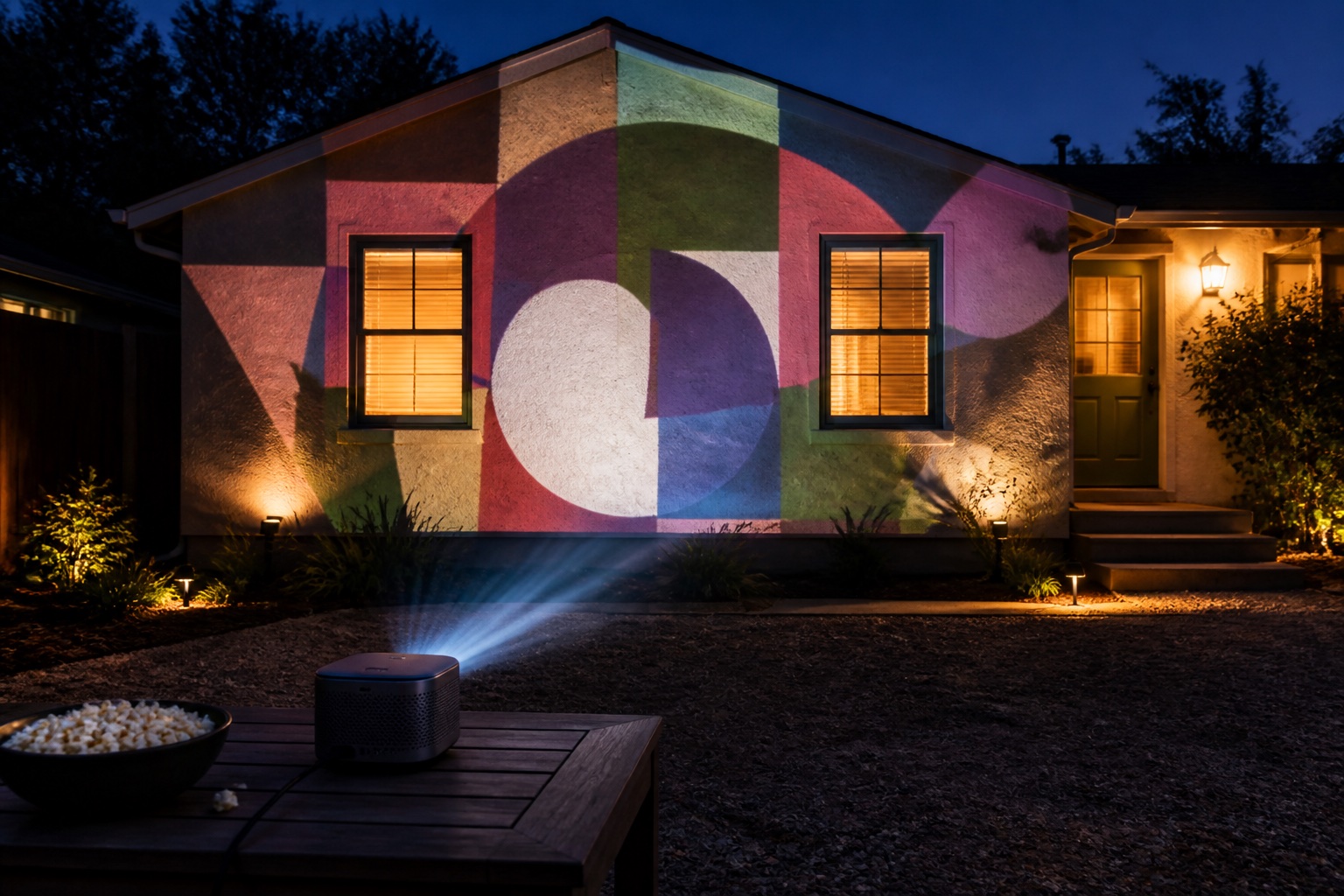
Our recommendation
Our pick is the XGIMI Horizon 20 Pro. Its 4,100 ISO lumens is enough for a pale single or double garage door after dark, and its 1.2–1.5:1 zoom and lens shift let it sit in the driveway without awkward angles. If you want the brightness for less and can live without 4K and Google TV, the BenQ TH575 is rated at 3,800 ANSI lumens. For a short driveway, the short-throw Optoma GT2000HDR fills a single door from about a metre away. Small battery projectors look faint at this size; keep them for windows.
Quick comparison
| Projector | Best for | Brightness (lumens) | Rating standard | Resolution | Throw ratio | Where to buy |
|---|---|---|---|---|---|---|
| XGIMI Horizon 20 Pro | Best for most garage doors | 4,100 | ISO | 3840×2160 (pixel-shift) | 1.2–1.5:1 | View on Amazon ↗ |
| BenQ TH575 | Brightness for less | 3,800 | ANSI | 1920×1080 | 1.49–1.64:1 | View on Amazon ↗ |
| Optoma GT2000HDR | Short driveways | 3,500 | Not stated | 1920×1080 | 0.496:1 | View on Amazon ↗ |
| XGIMI Horizon 20 Max | Dark doors, brick and wider garages | 5,700 | ISO | 3840×2160 (pixel-shift) | 1.2–1.5:1 | View on Amazon ↗ |
XGIMI Horizon 20 Pro
Specs-based pick
Best for most garage doors. Bright enough for a pale single or double door after dark, and the zoom means one driveway spot can fill either. XGIMI lists lens shift of up to ±120% vertically, so it can sit low and still hit the door without keystone correction. Google TV is built in, so Lazy Lighting Link can send the show wirelessly from your phone. It runs on mains power (up to 230 W) and is rated for 0–40°C (32–104°F). Disclosure: we make Lazy Lighting.
Check price & availability (paid link) ↗BenQ TH575
Specs-based pick
Brightness for less. A lamp-based 1080p projector with a slightly longer throw, so it sits further back: about 3.6 m (12 ft) to fill a single door's width and about 7.3 m (24 ft) for a double. Connect your phone or player by HDMI. BenQ lists 260 W typical power draw and 0–40°C operation.
Check price & availability (paid link) ↗Optoma GT2000HDR
Specs-based pick
Short driveways. The short-throw lens fills a 2.4 m (8 ft) door from about 1.2 m (4 ft) and a double door from about 2.4 m (8 ft), so it can sit close to the door and out of the walking path. Optoma does not say whether its 3,500 lumens is an ANSI or ISO figure, so treat it as approximate. Laser light source, rated for 0–40°C.
Check price & availability (paid link) ↗XGIMI Horizon 20 Max
Specs-based pick
Dark doors, brick and wider garages. The same zoom and lens shift as the Horizon 20 Pro with considerably more light, for a dark-painted or wooden door, a three-car garage, or a show that starts at dusk. Up to 280 W and 5.4 kg.
Check price & availability (paid link) ↗How we chose: these picks are based on manufacturer specifications; we have not tested them ourselves. Check current specifications and availability before buying. As an Amazon Associate we earn from qualifying purchases.
What else you need
- Wired phone connection: Anker 5-in-1 USB-C hub with HDMI. If your Wi-Fi does not reach the driveway, run the show over HDMI instead. The hub adds a USB-C power-delivery input so a USB-C phone charges while it plays all evening. Lightning devices need Apple's Lightning Digital AV Adapter. Check price & availability (paid link) ↗
- Power to the driveway: Outdoor-rated extension cord. Every projector here runs on mains power. Use a cord rated for outdoor use, plugged into a GFCI-protected outlet, with the connection kept off the ground and covered.
Why a garage door needs a bright projector
Size is the problem. A typical single garage door is about 2.4 × 2.1 m (8 × 7 ft), roughly 5 square metres. A double is about 4.9 m (16 ft) wide, roughly 10 square metres. A window is closer to one. The projector's light is spread across that whole area, and it is competing with porch lights, coach lights beside the door and streetlights.
That is why small portables look faint here. The Nebula Capsule 3 Laser is the projector we use in our own videos, and we keep it for windows and props: spread across a double door, its 300 ANSI lumens works out to roughly a fourteenth of the light per square metre that the Horizon 20 Pro delivers. Battery projectors also tend to dim themselves when unplugged; Nebula's support page lists lower brightness figures for the Capsule on battery.
How many lumens for a garage door?
These are starting points for after full dark, with nearby lights switched off. Compare ANSI or ISO figures only. Cheap units that advertise five-digit lumen numbers with no standard attached cannot be compared with them.
- Pale single door on a dark street: about 3,000 lumens.
- Double door, a streetlight nearby, or a show that starts at dusk: 4,000 or more.
- Dark-painted or wooden door: 5,000 or more, or shrink the image to the area that matters.
- Whole house front: 4,000–5,000 or more for a pale single-storey front; brick, dark siding or two storeys need more, or a section at a time.
Throw distance: how far back to put the projector
Distance is roughly image width × throw ratio. With the Horizon 20 Pro at its widest setting (1.2:1), that is about 1.2 m back for every metre of width. Measure from the lens to the door and add room behind for the stand and cable.
One catch: a single garage door is nearly square, while a projector image is 16:9. Fill the door's width and the picture covers only about two-thirds of its height, which is fine for a face or ghost in the middle. To fill it top to bottom, size the image to the door's height and mask the extra width to black. A double door is wider than 16:9, so filling its width covers its full height. Our throw-distance calculator does the same sums for any projector.
- Single door, fill the width (2.4 m): about 2.9–3.6 m (10–12 ft) across the Horizon 20 Pro's zoom range.
- Single door, fill the full height (2.1 m): about 4.5–5.7 m (15–19 ft), with the sides masked.
- Double door (4.9 m): about 5.9–7.3 m (19–24 ft).
- Short-throw Optoma GT2000HDR: about 1.2 m (4 ft) for a single door's width, 2.4 m (8 ft) for a double.
Where to put it: yard, driveway or across the street
The driveway, centered on the door, is usually best. Set the lens at roughly the door's mid-height so the image lands square and the horizontal panel seams cast less shadow. Lens shift helps when the projector has to sit lower. Keep cars out of the driveway for the night and mark the stand's position so it goes back in the same place.
The yard, off to one side, works when trick-or-treaters need the driveway. The angle stretches the image, which a mapping app can correct, but the far side of the door ends up dimmer and softer, so keep the angle modest.
Across the street is a bad idea. It is a public road or a neighbor's property, cars and people cross the beam, and at 12–15 m even the Horizon's longest zoom setting (1.5:1) throws an image 8–10 m wide, so most of the light misses the door. Wherever you set up, keep the beam out of the path visitors walk, or raise the projector so they pass underneath.
Weather and power
None of the projectors here are weatherproof. Do not run them in rain, and keep them off wet grass on a table or sturdy stand. A canopy or patio umbrella with open sides keeps drizzle and dew off while leaving the vents clear. Never run a projector in a sealed box: it needs to exhaust heat. XGIMI rates the Horizon 20 Pro for 0–40°C (32–104°F), so check the forecast on cold nights.
Plan an outdoor-rated extension cord from a GFCI-protected outlet, with the connection off the ground and covered. Run the cord along the edge of the driveway, or under a cable cover where people walk. When you bring the projector in, let it warm to room temperature before switching it on again so any condensation can clear.
Content that reads from the street
People see a garage door from the sidewalk or across the road, often while walking. Big, slow, high-contrast scenes on pure black work best: one giant face, drifting fog, ghosts that cross the whole door. Fine detail and small text disappear at that distance, and fast motion turns to noise.
Switch off the coach lights beside the door and any porch light that falls on it, because they wash out the edges first. If the door has windows, mask them to black rather than projecting onto glass. And keep the light on the door: bright animation spilling toward the road distracts drivers on a night full of children.
Mapping the door from your phone
A plain video spills a rectangle of light past the door onto the wall and driveway. Projection mapping fits the scene to the door instead, so everything outside the door stays dark. The garage door section of Lazy Lighting's Halloween guide covers drawing one shape over the door and filling it with a scene; a sectional door can also be mapped panel by panel.
With a Google TV projector such as the Horizon 20 Pro, Lazy Lighting Link lets the phone stay indoors and send the show over Wi-Fi, as long as the signal reaches the driveway. Keep the phone on its charger and, on iPhone, set Auto-Lock to Never so it does not sleep mid-loop. For your own loops, start with Lazy Lighting's list of free Halloween projector videos.
Frequently asked questions
How many lumens do I need to project onto a garage door?
About 3,000 ANSI or ISO lumens for a pale single door after dark. A double door, nearby streetlights or a dusk start call for 4,000 or more, and a dark door for 5,000 or more.
How far should the projector be from the garage door?
Multiply the image width by the throw ratio. With a 1.2:1 projector, a 2.4 m single door needs about 3 m (10 ft) and a 4.9 m double door about 6 m (20 ft). A short-throw projector can fill a single door from about 1.2 m.
Can I use a mini or portable projector on a garage door?
It will show an image, but it will look faint. A 300-lumen portable spread across a garage door gives a small fraction of the light per square metre of a 4,000-lumen projector, and many portables dim themselves on battery. Use them for windows and props instead.
Do I need a projector screen for a garage door?
Not for a white or pale door; it is already a good surface. A dark or wood-grain door absorbs much of the light, so either use a brighter projector or hang a white screen or sheet over the door.
Can I leave the projector outside on Halloween night?
Only while it is dry and you are around. Keep it under an open-sided cover, off wet ground and on an outdoor-rated cord, and bring it in at the end of the night. These projectors are not weatherproof.
Where is the best place to put a garage door projector?
In the driveway, centered on the door, with the lens at about the door's mid-height. Avoid setting up across the street: the image gets too wide for the door and people and cars cross the beam.
Prices, availability, and specifications can change by market and date. Confirm current manufacturer documentation and the retailer listing before purchasing.
- XGIMI Horizon 20 Pro official specifications ↗
- RTINGS: XGIMI Horizon 20 Pro review (pixel-shift 4K) ↗
- BenQ TH575 official specifications ↗
- Optoma GT2000HDR official specifications ↗
- XGIMI Horizon 20 Max official specifications ↗
- Expert Reviews: XGIMI Horizon 20 Max review (0.47-inch DMD, pixel shift) ↗
- Nebula Capsule 3 Laser official specifications ↗
- Nebula support: battery brightness modes, including Capsule 3 Laser ↗
- Lazy Lighting: Halloween projection mapping from your phone (our app) ↗
- Lazy Lighting: free Halloween projector videos ↗
- Lazy Lighting: connect a phone or tablet to a projector ↗
- Lazy Lighting: recommended projector hardware ↗